Pickleball: 10 reasons to start playing today
Pickleball: rules and why to try the sport of the moment
Thanks to its hybrid nature and the relative simplicity of its rules, pickleball is the ideal sport for anyone looking to approach racket sports in an accessible way, while still maintaining a competitive edge.
In recent years, pickleball has established itself as one of the fastest-growing sports worldwide. A discipline that has won over people of all ages thanks to a surprisingly effective combination of movement, strategy, fun, and social interaction, making it accessible to beginners while remaining engaging for those with a background in more structured sports such as tennis or padel.
What truly sets pickleball apart from other racket sports is, however, its particularly successful balance between simplicity of play and technical depth. On one hand, clear rules and an immediate learning curve allow even beginners to get into the game quickly; on the other, space management, rhythm control, court positioning, and the ability to read an opponent introduce a strategic complexity that keeps advanced players engaged. This allows them to focus on refining precision, concentration, and movement awareness.
What is pickleball? Key features and game dynamics
Pickleball is a racket sport that originated in the United States in the late 1960s and has since spread to many parts of the world. It can be played in both singles and doubles and was born from a blend of tennis, badminton, and table tennis, reinterpreted within a modern, simplified game system designed to encourage longer rallies and a balanced pace.
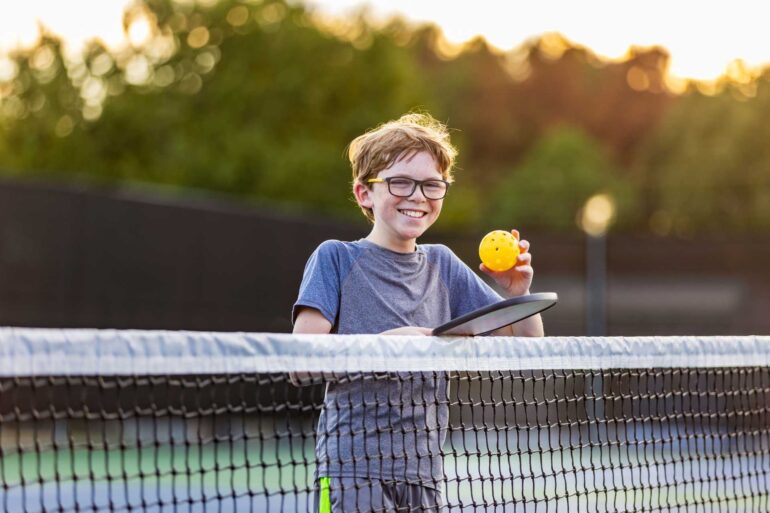
The game is played on a smaller court, with a net lower than the tennis one, specifically designed to slightly slow down the speed of play. This reduces the aggressiveness of shots and places greater emphasis on precision, touch, and control. Another distinctive feature is the perforated plastic ball, which further moderates speed and improves shot stability, making rallies more readable and extending play duration.
These characteristics help reduce overall physical impact, limit abrupt movements, and encourage longer exchanges, creating a playing experience that is fluid, engaging, and accessible, while still rich in technical and tactical nuances.
Pickleball rules: how does the game work?
The rules of pickleball are one of the key reasons for its success, as they are designed to be intuitive and easy to learn, while still introducing mechanisms that keep the game interesting over time. The serve must be executed underhand, striking the ball below waist level, and must clear the net diagonally into the opponent’s service court, within the boundaries of the sidelines and baseline. Volley serves are not allowed, and at least one foot must remain behind the baseline at the moment of contact.
After the serve, the ball must bounce once on each side before it can be volleyed — a rule known as the two-bounce rule. This encourages longer, more controlled rallies and prevents overly aggressive play in the opening moments of each point. One of the most distinctive aspects of pickleball is also the so-called kitchen, or non-volley zone: an area extending 2.13 meters (7 feet) from the net on both sides, where players are not allowed to hit the ball in the air. This rule forces players to carefully plan their approaches to the net, manage positioning and timing with precision, and use angles and strategy to draw errors from opponents.
Scoring in pickleball follows a unique system in which only the serving team can score points. Matches are typically played to 11 points, with a minimum two-point advantage required to win the game, potentially extending play in the case of close scores. In doubles, players rotate service positions in an orderly manner according to official rules: the right-side player serves first at the beginning of the game, and after losing the serve, the turn passes to the other partner.
Pickleball: 10 Reasons to Try This Racket Sport
Below are ten concrete reasons why taking up pickleball can transform a sports routine into an enjoyable, stimulating, and rewarding experience, suitable for all ages and fitness levels.
1. Easy to learn, endless room to grow
Pickleball combines accessibility with technique, allowing almost anyone to start playing right away. Even those who have never held a racket can quickly learn the basic rules and step onto the court within minutes, enjoying early rallies without frustration.
This initial ease, however, is only the beginning. Every match offers opportunities to refine advanced skills such as shot precision, ball control, strategic positioning, and the ability to read and anticipate an opponent’s moves. Rallies become true exercises in continuous improvement, where both beginners and experienced players find constant stimulation, learn to manage pressure, and experiment with different strategies.
2. A full-body workout
Despite the smaller court size, pickleball provides a surprisingly comprehensive physical workout. Continuous lateral movement, quick accelerations, and frequent changes of direction engage the legs, arms, core, and cardiovascular system, improving endurance, agility, and coordination.
The pace of play keeps the heart rate elevated without overloading joints and muscles, delivering tangible health benefits even during relatively short playing sessions.
3. Low impact and reduced risk of injury
One of the reasons pickleball is growing so rapidly is its safety and sustainability. The lower net, controlled ball bounce, and balanced pace significantly reduce stress on knees, ankles, shoulders, and the lower back, making it ideal even for those with joint or muscular concerns.
The alternation between moments of intense focus and brief pauses between rallies also makes the activity more sustainable than many high-intensity sports, allowing for regular practice without excessive fatigue.
4. Boosts mental focus and strategic thinking
Pickleball is not just a physical workout — it is also a powerful mental exercise. Every rally requires attention, quick reflexes, and decision-making skills. Players must read ball trajectories, anticipate opponents’ actions, and choose the right shot in a split second, training memory, mental agility, and concentration.
The non-volley zone adds an essential strategic layer, requiring precise decisions about when and where to attack, fostering planning skills and tactical awareness.
5. Social interaction and shared enjoyment
The doubles format, player rotation, and constant interaction make pickleball a naturally social and inclusive sport. It offers the perfect opportunity to meet new people, strengthen existing relationships, and share moments of fun with friends or family. The cooperative yet competitive nature of the game creates a unique sense of community, where competition remains engaging but always positive.
6. Suitable for all ages and skill levels
Pickleball is an exceptionally inclusive sport that adapts easily to all ages and levels of ability. Children, adults, and seniors can play together, adjusting pace and intensity to individual capabilities.
This makes it ideal for families, mixed groups, and sports communities, ensuring that everyone can participate without feeling excluded. The scalable difficulty and wide range of strategies allow each player to find the right balance between challenge and enjoyment.
7. Minimal equipment, maximum convenience
Getting started with pickleball requires only a paddle, a perforated ball, and a regulation court — no complex or expensive equipment. This logistical simplicity removes financial and organizational barriers, allowing the sport to be played in a variety of settings: at home, in parks, sports centers, or resorts. This flexibility makes pickleball ideal for those looking to integrate physical activity easily into their daily routine.
8. Improves balance, coordination, and body awareness
Constant movement, rapid direction changes, and precise ball control enhance balance, stability, and coordination, increasing overall body awareness.
These benefits extend beyond the court, positively impacting everyday life by improving posture, reflexes, and reaction time, while reducing the risk of falls and injuries.
9. Encourages consistency and long-term motivation
One of pickleball’s greatest strengths is its ability to maintain motivation over time. Fast-paced matches, varied rallies, and gradual improvement without frustration keep the game engaging and prevent the monotony that often leads people to abandon physical activity. Each session offers new challenges, personal goals, and the satisfaction of tangible progress, encouraging regular practice and long-term physical and mental benefits.
10. Professional Pathways and Qualified Coaching
For those who wish to go beyond recreational play and develop a deeper understanding of pickleball, structured professional pathways are available—such as those offered by the Pickleball Star Academy.
Guidance from qualified coaches allows players to focus on technical fundamentals, advanced rule comprehension, and strategic match management, supporting measurable and progressive improvement. Through personalized programs and training sessions tailored to individual goals and skill levels, pickleball evolves from a simple pastime into a true growth journey, leading from initial enjoyment to a more conscious, advanced, and competitive practice.
In essence, pickleball stands out as a complete and versatile discipline, capable of combining physical well-being, mental stimulation, and the pleasure of shared experiences—offering anyone the chance to discover a dynamic, accessible, and deeply rewarding sport, regardless of age or starting level.
Pickleball Star Academy: Learning Through Fun at Forte Village Resort
Approaching pickleball in a simple, intuitive, and enjoyable way is now possible at the exclusive Forte Village Resort in Santa Margherita di Pula. This five-star destination has been a benchmark in sports education for over a decade, offering state-of-the-art facilities and world-class coaches to guide both adults and children toward excellence.
Here, guests can find the brand-new Pickleball Star Academy, open from May 25 to September 11—one of the latest additions to the resort’s more than twenty sports academies, set within 50 hectares of lush greenery. Among these are also the prestigious Swimming Academy, where guests canrefine their technique under the guidance of champions such as Domenico Fioravanti and Martina Moravcová, the popular Tennis Academy, designed to develop true tennis champions, and the Mountain Bike Academy, offering children and adults the chance to tackle trails of varying difficulty surrounded by Sardinia’s natural beauty.
After training sessions, guests can rejuvenate body and mind at the renowned Acquaforte Thalasso & Spa, which offers a wide range of treatments, including thalassotherapycircuits and relaxing couples massages. To complete the experience, the resort’sMichelin-starred restaurantsprovide exceptional culinary creations, including Belvedere byGiuseppe Molaro, Terrazza San Domenico by Massimiliano Mascia, and Beachcomber by Heinz Beck.
For more information or to book lessons at one of the Forte Village Academies, call +39 070 9218818 or write to holiday@fortevillage.com.
Looking to discover pickleball and enjoy a dream vacation in an authentic paradise? Discover Forte Village Resort in Sardinia.