Peated whiskey: history, production, and key characteristics
Peated whiskey: a distillate with a distinctive character and an unmistakable taste
Intense and rich in nuance, peated whiskey captivates with a complex aromatic profile, where smoky notes intertwine with hints of wood, spices, and delicate marine notes, creating a distillate with unmistakable charm.
Among the great protagonists of the spirits world, peated whiskey undoubtedly holds a place of honour thanks to its strong identity, distinctive character, and a personality that stands out within the vast landscape of international productions. It is not simply a beverage with an intense flavour, but a product that contains a true universe of sensations, capable of engaging the palate, sight, and sense of smell, accompanying those who taste it on a genuine journey of discovery through its places of origin.
The charm of this refined beverage lies in its ability to combine elegance and intensity, offering a unique profile that over time has conquered enthusiasts, collectors, and curious drinkers around the world. Unlike other lighter and more immediate expressions, peated whiskey presents a more complex and structured personality, ideal for those who wish to approach a more conscious tasting experience. Each tasting thus becomes a moment in which to rediscover the value of tradition, craftsmanship, and the pursuit of quality, elements that have contributed to making this type of distillate one of the most appreciated among connoisseurs.
Approaching the world of peated whiskey, therefore, means discovering a distillate with a strong identity, capable of transforming a simple tasting into an experience rich in emotions. A product that continues to fascinate precisely because of its ability to combine tradition, refinement, and an unmistakable character.
Peated whiskey: meaning, characteristics, and secrets
When talking about peated whiskey, reference is made to a very specific characteristic related to the production method and, consequently, to the aromatic profile of the distillate. The term “peated” derives from the use of peat during one of the most important stages in the processing of malted barley, namely, a natural organic material formed by the slow decomposition of plant remains accumulated in humid environments over thousands of years, and which, thanks to its calorific properties, has been a valuable source of fuel in northern European regions for centuries.
The distinctive feature of this element lies in the smoke released during combustion. When it is used to dry the malt after germination, peat releases aromatic compounds that are absorbed by the barley grains, directly influencing the character of the future distillate. It is precisely this stage that gives whiskey its typical smoky notes, making it immediately recognisable and distinguishing it from non-peated versions.
At the same time, the intensity of the peating process can vary considerably. Some whiskeys display a delicate smokiness, barely perceptible and perfectly integrated with the other aromatic components, while others express a much stronger character, with notes of smoke, ash, damp earth, and spices dominating both the nose and the palate. These differences are always closely linked to the quantity of organic material used, the length of time the malt is exposed to the smoke, and the production choices of each distillery.
History of peated whiskey: from Scottish origins to international fame
The history of peated whiskey has its roots in the ancient traditions of Scotland, where whiskey production developed as early as the Middle Ages. In the northern regions and western islands of the country, peat represented an abundant and easily available natural resource. Due to the limited availability of wood, local communities began using it as their main fuel for heating homes and powering the kilns used to dry the malted barley intended for whiskey production. During this phase, the smoke released often came into contact with the barley grains, infusing the malt with intense and persistent aromas.
What initially began as a simple practical necessity gradually became a distinctive element of local production. Master distillers realised that these particular smoky notes gave the distillate a unique identity and began to enhance them, passing down production techniques from generation to generation that still characterise some of the most prestigious labels today.
The areas that have contributed most to the reputation of peated whiskey are the Inner Hebrides, particularly the island of Islay, considered the true home of this type of distillate. Thanks to its extensive peat deposits, its climate strongly influenced by the Atlantic Ocean, and the long-standing tradition of its local distilleries, Islay has become synonymous with intensely peated whiskey. It is no coincidence that some of the most renowned productions in the world come from this small island, appreciated for their distinctive notes of smoke, sea salt, iodine, and spices.
Other Scottish regions have also contributed to the development of this distillation style: in the Highlands, on the islands of Skye, Jura, Mull, and Arran, as well as in some distilleries of the Orkney Islands, peat is used with different levels of intensity, creating whiskeys that express very different interpretations, some more delicate and balanced, others stronger and more complex.
During the twentieth century, peated whiskey progressively crossed the borders of Scotland, winning over enthusiasts around the world. Today, this product is also reinterpreted by distilleries in countries such as Japan, Ireland, the United States, and even Italy, which experiment with the use of peat to create original products. Despite these new interpretations, Scotland continues to represent the main international reference point for the production of peated spirits, thanks to a centuries-old tradition that still manages to combine authenticity, craftsmanship, and excellence.
How peated whiskey is produced
The production of peated whiskey follows a long and meticulous process, in which each stage contributes to defining the character of the distillate. As previously mentioned, while sharing many steps with traditional whiskey production, this type of distillate stands out for the use of peat during the malt processing stage, an element that determines its aromatic profile and personality.
Malted Barley Processing
The production process begins with the malting of barley. The grains are soaked in water and left to germinate for several days in order to activate the enzymes required to transform starches into fermentable sugars.
Once the desired level of germination has been reached, the process is stopped through drying. It is precisely during this stage that peat comes into play: the smoke generated by its combustion passes through the malt and deposits aromatic compounds onto the grains, creating the characteristic smoky notes of whiskey. The degree of exposure to smoke determines the intensity of the peating process and represents one of the elements that distinguishes the different productions.
Fermentation and Distillation
Once malting is complete, the malt is ground and mixed with hot water to obtain a sugar-rich liquid known as wort. At this point, yeast is added, initiating fermentation and transforming sugars into alcohol while developing the first aromatic components.
The fermented liquid is then subjected to distillation, generally inside traditional copper stills, whose shapes and sizes can significantly influence the final result. This stage allows the alcohol to be concentrated and the most valuable fractions of the distillate to be selected, contributing to the definition of its elegance and complexity.
Maturation in Barrels
Once distillation is complete, the whiskey is transferred into wooden barrels, where it remains to mature, often for several years. During this period, the distillate slowly evolves, absorbing aromas and compounds from the wood and developing greater harmony among all its components.
The barrels, often previously used for bourbon or sherry, enrich the whiskey with notes of vanilla, honey, dried fruit, caramel, and spices, which integrate with the characteristic smoky flavour of peat. The length of ageing and the type of barrel contribute to making each label different from the others – the result is a wide variety of interpretations of the same product.
The main characteristics of peated whiskey
Peated whiskey is appreciated for its extraordinary aromatic complexity and its ability to offer an intense yet balanced sensory experience. Each label has its own characteristics, influenced by origin, production method, and maturation period, but all share a strong identity that makes them immediately recognisable.
Intense and Recognisable Aromas
The most distinctive aspect of peated whiskey is its aromatic bouquet. On the nose, notes of smoke, burnt wood, ash, and charcoal often emerge, accompanied by spicy, balsamic, and sometimes marine nuances. Whiskeys from coastal areas may also reveal hints of sea salt, seaweed, and ocean breeze.
With ageing, these sensations become even richer thanks to the contribution of the wood, bringing out aromas of vanilla, honey, dried fruit, cocoa, and delicate toasted nuances that make the profile even more elegant.
A balanced and persistent taste
On the palate, peated whiskey stands out for its full-bodied, smooth, and enveloping structure. The smoky notes represent its most distinctive feature, but they do not overpower the other aromatic components, which contribute to creating a harmonious and well-balanced whole.
During the tasting, it is possible to perceive a continuous evolution of flavours, with hints of spices, wood, dried fruit, and delicate sweet notes accompanying the sip through to the finish. The long aromatic persistence is one of the qualities most appreciated by connoisseurs, as it allows new nuances to continue emerging even after tasting.
How to best enjoy a peated whiskey
To fully appreciate all the characteristics of a peated whiskey, it is important to dedicate the right amount of time and attention to the tasting experience. The complexity of its aromatic profile requires a slow and mindful approach, capable of enhancing every nuance developed during production and maturation.
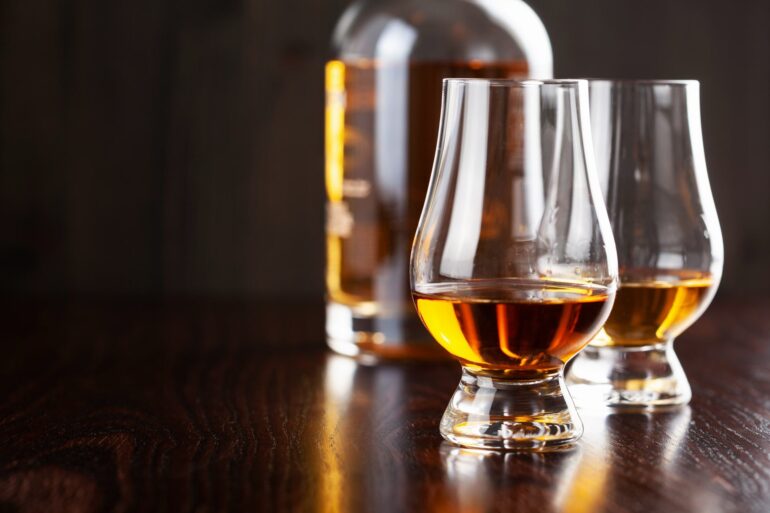
It is generally served neat, at room temperature, in a tasting glass designed to enhance the concentration of aromas. Before tasting, it is advisable to observe its colour, slowly bring the glass closer to the nose to perceive its aromas, and only then proceed with small sips, allowing the distillate to spread evenly across the palate. Some enthusiasts choose to add a few drops of natural water, a practice that can help open up the aromatic bouquet and make certain nuances more evident without altering its balance.
Bar Bandiere at Forte Village Resort: the ideal place to enjoy peated whiskey in an exclusive setting
To experience an even more complete tasting journey, peated whiskey finds its ideal setting in elegant and relaxed environments, capable of transforming a simple tasting into a moment dedicated to pleasure and conviviality.
Among the destinations that best embody this philosophy is Forte Village Resort, a prestigious complex overlooking the southern coast of Sardinia, just a few steps from some of the island’s most beautiful beaches, and internationally renowned for the excellence of its hospitality. The resort features numerous Michelin-starred and gourmet restaurants, elegant lounge bars, a renowned spa, swimming pools, more than twenty sports academies, as well as services dedicated both to families and to those wishing to enjoy a holiday focused on relaxation and luxury.
Within this setting is Bar Bandiere, one of the resort’s iconic venues. Characterised by a sophisticated and welcoming atmosphere, it is the ideal place to enjoy a moment of tranquillity after dinner or spend a pleasant evening accompanied by live music. Here, guests can choose from a refined selection of cocktails, mixology creations, and spirits, including prestigious peated whiskeys.
For more information about Bar Bandiere or to book a stay at Forte Village Resort, it is possible to call +39 070 9218818 or send an email to holiday@fortevillage.com.
Would you like to discover the secrets of peated whiskey and experience a dream holiday in a true paradise? Book your stay at Forte Village Resort in Sardinia