Sardinian Sweets of Sant’Antoni ‘e su Fogu: The Authentic Flavors of the Island
Sardinian sweets: the delicacies of the Feast of Saint Anthony Abbot
Simple to prepare yet rich in flavor, Sardinian sweets are an integral part of the Sant’Antoni ‘e su fogu celebrations, an event celebrated across the island on the night between January 16th and 17th.
Within the landscape of Sardinia’s most deeply rooted and identity-defining popular traditions, the feast of Saint Anthony Abbot stands out as one of the most symbolically and communally intense moments. Celebrated between January 16th and 17th in numerous towns across the island, Sant’Antoni ‘e su fogu traditionally marks the symbolic start of the new rural year. This is a time of transition, during which the community gathers around a large bonfire lit in town squares or shared spaces, creating a visually and emotionally striking ritual. The fire assumes a purifying and propitiatory function, while collective participation strengthens social bonds and the sense of belonging.
In this context, food becomes a natural complement to the ritual, an element of hospitality and conviviality that accompanies the deeper meaning of the celebration. Among the various delicacies that are shared during the festive days are Sardinian sweets made with local and seasonal ingredients, such as honey, cheese, ricotta, and almonds.
The Sant’Antoni ‘e su fogu celebrations: the festival of fire and new beginnings
The Sant’Antoni ‘e su fogu celebrations represent one of the oldest and most symbolically rich rites of Sardinian tradition, marking the transition to a new agricultural and pastoral cycle. The feast, dedicated to Saint Anthony Abbot, takes place between January 16th and 17th and revolves around the lighting of the large community bonfire. These are prepared in the days prior with the collective gathering of wood and ignited in squares, open spaces, or near churches, becoming the visual, symbolic, and emotional centerpiece of the celebration.
The primordial element of fire assumes a purifying and propitiatory function: it burns away the past, protects against the cold and winter hardships, and symbolizes the light that accompanies the start of a new season of work in the fields and pastures. Around the flames, the community engages in traditional songs, spontaneous dances, and social gatherings, creating an intergenerational space where elders, adults, and children share gestures, stories, and rituals passed down through time. In many locations, the festival is accompanied by religious processions and the blessing of animals, confirming Saint Anthony Abbot’s role as protector of the rural and pastoral world, a central element of Sardinia’s historical identity.
The celebration is never an isolated event but the result of collective participation that begins days earlier and culminates on the night of the bonfire, transforming the square into a symbolic place of belonging, memory, and cultural continuity. Sant’Antoni ‘e su fogu thus becomes a moment in which the sacred and the secular coexist harmoniously, where religious ritual intertwines with community life, and where fire acts as a catalyst for relationships, identity, and tradition.
Typical Sardinian sweets: the delicacies accompanying the Feast of Saint Anthony Abbot
Within this ritual and communal context, typical Sardinian sweets, much like the treats associated with Carnival, find their place as a complementary element of conviviality, enriching the celebration without ever replacing its central symbolic meaning. Prepared domestically in the days leading up to the festival, Sardinian sweets are shared among family members, neighbors, and visitors as a gesture of hospitality and abundance, reflecting a culinary culture deeply tied to seasonality, the availability of ingredients, and knowledge handed down from generation to generation.
The variety of typical Sardinian sweets and local recipes, including different types of honey-based desserts, illustrates the richness and diversity of the island’s pastry tradition, with preparations that vary from area to area but share a common foundation of simple and symbolic ingredients such as honey, cheese, ricotta, almonds, and semolina – all central elements of Sardinia’s agro-pastoral heritage.
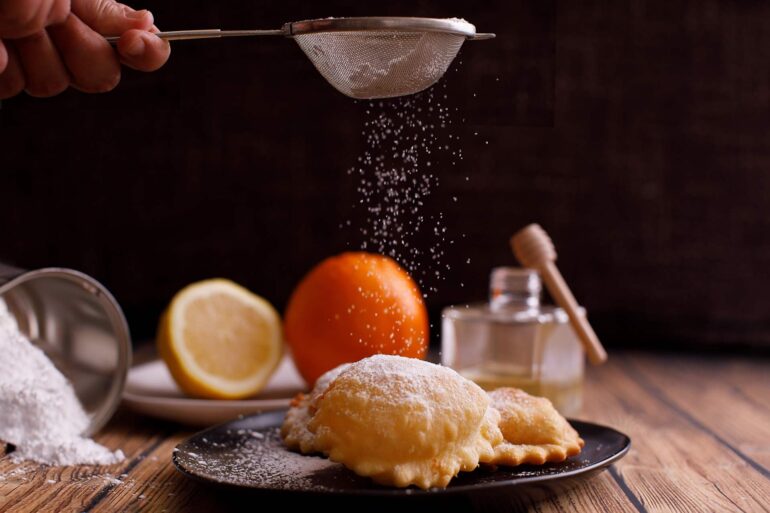
Among the most popular honey- and ricotta-based Sardinian sweets are seadas or sebadas, made from a semolina pastry filled with fresh cheese, fried, and served hot with local honey, often chosen for its aromatic and slightly bitter character, such as strawberry tree honey. Alongside these are other ricotta-based sweets like pardulas or casadinas, flavored with citrus zest and saffron, soft and delicately aromatic, examples of home-style pastry that is refined in its simplicity.
Not to be overlooked are also almond-based Sardinian sweets, such as Sardinian amaretti, made with finely ground almonds, egg whites, and sugar. Their intense flavor and long shelf life make them ideal for sharing throughout the winter festivities. Fried Sardinian sweets, typical of the winter season, are also prominent: origliette or orillettas, thin crispy pastries coated with honey or sugar; zippulas, fried semolina doughnuts with eggs and orange zest, often enriched with saffron or brandy; and frigjolas, fried dough balls dipped in hot honey, simple yet extremely flavorful.
Other Sardinian sweets of Sant’Antoni ‘e su fogu: lesser-known recipes and local traditions
Alongside the more widely known sweets, Sant’Antoni ‘e su fogu preserves a heritage of less familiar preparations, deeply connected to local identities and often made exclusively for this occasion. In several areas of Sardinia, particularly inland towns and regions of Barbagia and Ogliastra, the tradition calls for the preparation of specific delicacies, intended to be distributed after the bonfire is lit or shared during communal convivial moments.
Among these is su pistiddu, typical of some towns in Barbagia and central-eastern Sardinia, a dense and aromatic pastry made with a simple dough casing filled with sapa (cooked grape must), semolina, and citrus zest. Sas cozzuleddas, common in Ogliastra, consist of thin pastry filled with a rich mixture of almonds, walnuts, honey, spices, and citrus, shaped into half-moons and baked in the oven.
In some Barbagia communities, such as Mamoiada, the festival includes the preparation of caschettas and tillicas. These more elaborate sweets, combining almonds, honey, saffron, and saba, are hand-shaped according to codified traditional forms and – again – are slowly baked, often in wood-fired ovens.
Other examples of traditional regional treats include is pirichittus, small dry and light bites glazed with sugar and delicate aromas, and sa paniscedda, typical of some Ogliastra areas, made once again with flour, sapa, dried fruit, spices, and orange zest, often shaped simply and brushed with cooked grape must after baking. Last, but not least, is su pan’e saba, a sweet bread enriched with dried fruit and cooked grape must, prepared during the winter months and shared during festivals as a symbol of abundance and good fortune.
All these typical Sardinian sweets are not merely desserts but carriers of memory and cultural identity, capable of narrating through taste a heritage made of gestures, family rituals, and ancient knowledge. Sharing them during Sant’Antoni ‘e su fogu means actively participating in a collective ritual that unites fire, community, and tradition, restoring to Sardinia’s flavors their most authentic and symbolic value.
Do you want to savor the best of typical Sardinian sweets and experience a fairytale holiday in an authentic paradise? Discover Forte Village Resort in Sardinia