Educational farm: learning from nature while having fun
Educational farm: an interactive space to discover nature and learn to respect it
Visiting an educational farm is an engaging and educational experience for the whole family, offering the opportunity to get close to animals, understand their needs, and learn the secrets of nature in order to develop respect, curiosity, and environmental awareness.
The educational farm represents an educational model that integrates traditional agricultural activities with structured learning paths aimed at understanding natural processes, animal management, and sustainable farming practices. In these contexts, knowledge is not limited to theory: observation and hands-on experience become essential tools for developing environmental awareness, practical skills, and an understanding of the biological cycles that regulate natural ecosystems.
The animals that live on an educational farm are managed according to welfare and care criteria, allowing visitors to observe natural behaviors and understand the specific needs of each species. At the same time, vegetable gardens and seasonal crops provide concrete examples of plant growth cycles and the need to manage resources such as water, soil, and nutrients in a balanced and sustainable way.
The interaction between animal and plant elements within an organized environment offers a comprehensive representation of natural mechanisms and ecological interconnections, promoting direct contact with nature and enabling the acquisition of valuable knowledge about how ecosystems function, the seasonality of products, and the impact of human activities on the environment. An extremely practical and engaging approach that proves particularly effective in fostering transversal skills such as responsibility, observation skills, empathy, and respect for biodiversity.
Educational farm: learning has never been so fun
Within a historical context in which everyday contact with nature appears increasingly rare and almost utopian, the educational farm stands out as a structured space for experiential learning, capable of combining knowledge, manual skills, and environmental awareness into a single coherent and formative experience.
It is not simply about visiting a rural place or observing farmyard animals, but rather about entering an organized ecosystem in which every element – from the stable to the vegetable garden, from the orchard to the craft workshops dedicated to the production of bread and cheese – becomes an opportunity for concrete learning and reflection on the delicate balances that regulate the natural world and our increasingly fragile relationship with it.
As the name suggests, educational farms pursue clear and multidimensional educational objectives. From a cognitive point of view, they foster understanding of biological cycles and the interactions between animals, plants, and the environment; from a practical perspective, they allow the acquisition of operational skills related to animal care, land cultivation, and the sustainable management of natural resources; from a values standpoint, they promote respect for living beings, ecological sensitivity, and individual responsibility toward the environment. Within this intertwining of theoretical and operational dimensions, learning does not remain limited to passive listening but takes shape through action, direct observation, and active involvement.
More specifically, adults and children can immerse themselves in structured activities that stimulate scientific curiosity, strengthen manual skills, and encourage the development of conscious ecological awareness, transforming time spent on the farm into a complete and deeply meaningful educational experience.
Animal care
One of the most significant aspects of an educational farm clearly concerns interaction with animals, which becomes a privileged tool for understanding the value of responsibility and the concrete meaning of respect toward living beings. Close observation makes it possible to study their natural behaviors, dietary needs, rest rhythms, and requirements for physical and psychological well-being, overcoming a superficial or purely recreational view of the human-animal relationship.
Daily management – including feeding, cleaning spaces, monitoring hygienic conditions, and checking health status – represents a practical exercise in care and attention. Through these activities, it becomes clear that animal welfare requires consistency, organization, and specific knowledge, and that every action has direct consequences on the overall balance of the rural environment.
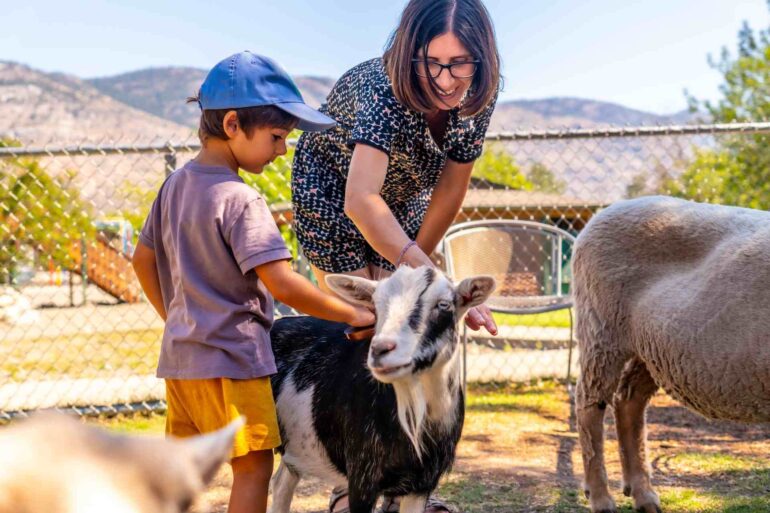
The presence of different species, such as hens, rabbits, goats, sheep, horses, and donkeys, also allows for the analysis of social behaviors, internal hierarchies, and communication methods, offering insights into relational dynamics and the natural balances that regulate group life. The experience thus becomes a laboratory of ethological observation, in which the educational dimension intertwines with the emotional one, fostering empathy and sensitivity.
Synergistic vegetable gardens and plant cultivation
Alongside the animal dimension, synergistic vegetable gardens represent one of the central elements of the educational farm, as they allow for a direct understanding of plant growth processes and the seasonal cycles that mark agricultural production. Through sowing, caring for seedlings and medicinal herbs, irrigation, and harvesting garden produce, awareness is gained of natural timing and the importance of environmentally respectful agriculture.
Soil preparation, nutrient management, the use of sustainable cultivation techniques, and attention to biodiversity become opportunities to deepen concepts such as soil fertility, crop rotation, and the reduction of environmental impact. Practical experience makes it clear that food is not an abstract product, but the result of a complex process that requires care, expertise, and respect for the land.
In many contexts, cultivation is integrated with food processing workshops, in which harvested products are used to prepare bread, preserves, cheeses, or other traditional foods. This phase makes it possible to connect knowledge of nature with local gastronomic culture, enhancing the link between territory, tradition, and sustainability.
Multisensory experiences and active learning
The educational farm stands out for its ability to activate multisensory learning, in which sight, touch, smell, and hearing all contribute to the construction of knowledge. Touching the soil, perceiving the scent of aromatic herbs, listening to the sounds of animals, and observing the colors of seasonal crops foster total involvement, making the experience memorable and deeply formative.
This experiential learning approach proves particularly effective in consolidating acquired information, as it integrates theory and practice into a single coherent path. Workshop activities, structured according to age groups and specific educational objectives, help develop problem-solving skills, collaboration, and critical thinking, transforming the farm into a true open-air pedagogical space.
Environmental education and sustainability
One of the fundamental objectives of an educational farm is to promote a culture of sustainability, understood not as an abstract concept, but as a set of daily practices aimed at protecting natural resources. Water management, waste reduction, recycling of organic materials, and the use of renewable energy become concrete examples of how productive activities and environmental respect can be combined.
Through guided paths and thematic activities, topics such as biodiversity, climate change, and ecosystem conservation are explored, encouraging the development of conscious and responsible environmental awareness. The educational farm thus assumes a central role in spreading virtuous behaviors capable of positively influencing everyday life as well.
Educational farm and Nature Park: an immersive experience at the Forte Village Resort
When the educational farm experience is set within a vast and carefully maintained natural context, learning is enriched by the opportunity to explore diverse natural environments and observe flora and fauna in protected and enhanced spaces. A significant example is the Nature Park of the Forte Village Resort, an area immersed in over fifty hectares of greenery within the resort in Santa Margherita di Pula, offering an educational path designed to bring adults and children closer to the knowledge of animals and Mediterranean ecosystems. In this context, the educational farm experience is integrated with a wide range of activities aimed at deepening the relationship between humans and nature in all its facets.
At the heart of the project is, precisely, the educational farm, home to animals belonging to Sardinian pastoral tradition, including sheep, rams, and local-breed goats, alongside other species that enrich the discovery journey. The presence of native breeds makes it possible to explore the link between livestock farming, rural culture, and territorial identity, offering a concrete look at agricultural practices historically widespread across the island. Particular attention is paid to health and safety: the animals come from certified farms, were born in controlled environments, and are constantly monitored from a veterinary standpoint.
Next to the animal area, the park also hosts a synergistic vegetable garden cultivated without the use of chemical substances. This space represents a concrete example of sustainable agriculture, based on plant cooperation and the maintenance of soil fertility through natural methods. In other words, an educational tool that makes it possible to understand seasonal cycles, the importance of crop rotation, and the value of food production that respects the natural ecosystem of this wonderful corner of Sardinia.
Within the Nature Park, there is also a space dedicated to meetings and workshops, the picturesque Caretaker’s House, where in-depth sessions, cooking classes, and thematic initiatives are organized to complete the educational farm experience, offering broader perspectives on sustainability and rural culture. In the evening, this environment transforms into an evocative setting immersed in the quiet of the Mediterranean scrub, where nature becomes the backdrop for dinners and convivial moments.
Access to the Nature Park is exclusively through guided tours, and the average duration of the route is about one hour, during which participants are accompanied by qualified staff. Several types of kits are available to enrich the experience with useful materials and themed gadgets, while children are also provided with an illustrated passport that visits more engaging places through games and collectible stamps. Whether or not one chooses to use the kit, booking is mandatory, and groups are limited in number, a choice that ensures a high-quality experience and protects animal welfare.
For more information about schedules, costs, and availability, or to make a reservation, it is possible to call +39 0709218818 or write an email to holiday@fortevillage.com.
Would you like to visit an educational farm and enjoy a sustainability-focused holiday in a true natural paradise? Discover the Forte Village Resort in Sardinia.