Cannonau di Sardegna: history, characteristics and perfect pairings
Cannonau di Sardinia: history and food pairings of an authentic expression of the island’s winemaking heritage
The origins of Cannonau di Sardinia are deeply rooted in the island’s geographical features and in the history of the communities that have inhabited it for centuries. From this authentic connection arise the finest pairings with local traditional products.
Cannonau di Sardegna represents one of the most authentic and distinctive expressions of Italy’s winemaking heritage, a wine that embodies strength from its terroir, memory from its rural traditions, and of course Sardinia’s own extraordinary ability to transform extreme environmental conditions into qualitative excellence. Speaking of Cannonau wine means telling the story of intense sunshine, sea breezes, poor yet mineral-rich soils, ancient knowledge shared through generations, which has allowed this grape variety to establish itself as an undisputed icon of the island.
The personality of Cannonau wines builds on a complex balance between power and finesse, between alcoholic warmth and freshness, between immediacy and the ability to evolve over time. The aromas of ripe red fruit, spices, aromatic herbs and mediterranean trees blend into a bouquet that seeks coherence with its original terroir. On the palate, its enveloping structure and soft tannins convey a sensation of harmonious fullness, which adapts to a large variety of gastronomic fields and offers a consistently distinctive tasting experience.
In other words, a wine that doesn’t follow trends but maintains its own identity still intact. It is the expression of a winemaking culture that has chosen continuity, patience, respect for the land as its founding values, transforming each single bottle into an honest tale of the Sardinia’s ground, its history, and its unique approach to producing and tasting wine.
History and origins of the wine Cannonau di Sardegna
The history of the wine Cannonau di Sardegna boasts deep roots, anticipating the modern classification of grape varieties by centuries. Numerous archaeological and ampelographic studies suggest in fact that vine cultivation in Sardinia was already widespread in the Nuragic era, while the arrival of the Phoenicians before, and the Romans later, further consolidated and spread wine production transforming wine into a key commodity in Sardinia’s economic and social life.
During the Middle Ages, Cannonau began to define its own central identity thanks to the work of monasteries and rural communities, who selected the most resistant vines suited to local soils. This process of natural adaptation allowed this grape variety to develop an extraordinary ability in withstanding drought, wind and severe temperature alterations, factors that today still characterize the most important production areas.
It was only in the 20th century, however, that Cannonau wine experienced a true qualitative renaissance. The introduction of more precise winemaking techniques, combined with the enhancement of the terroir and the creation of the Cannonau di Sardegna DOC designation, has elevated this wine to a real icon of regional and national excellence. At the same time, scientific interest in the connection between Cannonau, antioxidants and longevity has contributed to strengthening its prestige, making it one of the most well-known and appreciated sardinian wines worldwide.
Organoleptic characteristics of Cannonau di Sardegna
Cannonau distinguishes itself by a rich, deep and layered sensory profile, capable of varying significantly depending on production zones, vineyards altitude and the specific stylistic choices of producers. On the eye, Cannonau wine displays an intense ruby red color, often brilliant in younger bottles, gradually tending toward garnet while aging, the sign of natural evolution and of a structure that adapts well to time ever going on.
On the nose, Cannonau wines offer a broad and exciting bouquet of scents, featuring notes of ripe red fruits such as cherry, blackberry and plum, accompanied by hints of sweet spices, aromatic herbs and mediterranean trees. In more complex and refined Cannonau wines, instead, it’s also possible to sense nuances of leather, tobacco, cocoa and jam, giving even more depth and refinement to the olfactory experience.
On the palate, Cannonau di Sardegna feels warm, structured, harmonious, with present yet generally soft tannins, a good acidity that supports the palate and a long, satisfying finish. This combination makes this wine very well balanced and versatile, capable of accompanying rich dishes without being overpowering, yet suitable for sipping alone as a meditation wine.
The alcohol content, typically between 13-15%, contributes to its sensation of roundness and warmth, without compromising overall elegance anyway, especially in wines from hillside or mountain vineyards.
Production areas and types of Cannonau wines
Sardinian Cannonau finds its best expression in terms of production in different areas of the island, each one capable of giving wine a distinct and specific personality. The inland areas of Ogliastra and Nuoro, characterized by high altitudes and significant temperature variations, produce structured, intense and enduring wines, with deep aromas and a quite pronounced mineral component.
Barbagia, with its granite soils and cooler climate, produces elegant and complex Cannonau wines, usually characterized by a surprising freshness. In the Campidano and Sulcis areas, however, the warmer climate and lower altitudes favor the production of softer and fruitier Cannonau wines, ideal especially for younger and new consumers approaching this wine.
At the same time, this geographical diversity also translates into a difference in wine styles, reflecting both the features of the terroir and the producer’s methods. Young Cannonau is characterized by freshness, immediacy and fruity aromas, and is intended for relatively quick consumption, the best choice as a beverage for simple and convivial dishes.
Affinato or Riserva Cannonau, on the other hand, is made from select grapes and undergoes a time of maturation in wood barrels, enriching wine with even more aromatic complexity and structure and making it particularly suited to rich dishes and long bottle aging. Alongside these traditional types, organic and bio-dynamic Cannonau wines are increasingly gaining popularity, for an even more authentic expression of the original productive terroir while minimizing the interventions in the vineyard and in the cellar.
There are also lighter and contemporary interpretations of the Cannonau wine, designed for those seeking elegance, drinkability and versatility, an option for who wants to enjoy this amazing product without sacrificing the distinctive character of this grape variety.
The best food pairings with Cannonau wine
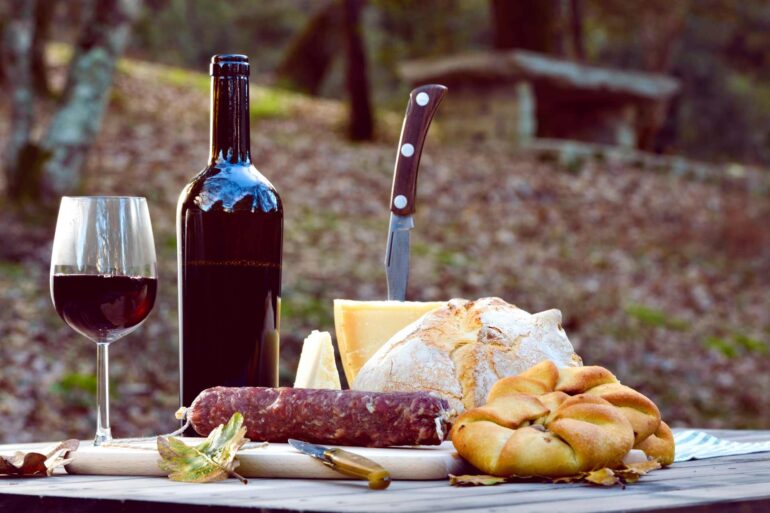
Cannonau wine stands out for its extraordinary versatility at the table, making it suitable for so many different food pairings. Traditionally, it pairs very well with red meats, roasts and hunt’s game, sharing its intensity and structure and shaping a harmonious balance of flavors.
Aged cheeses, especially sardinian pecorino, even when paired with the ever-present local bread, find in Cannonau wines an ideal companion to enhancing their savory flavors and aromatic complexity. Even pasta dishes with rich sauces, meat-based especially, or slow-cooked dishes pair perfectly with more structured varieties of Cannonau wines. In younger and fresher versions, Cannonau can also feel surprisingly good with flavorful fish dishes, such as tuna or amberjack, or with mediterranean and contemporary cuisine, demonstrating a flexibility that goes well beyond the most traditional pairings from the island’s own cuisine.
To fully appreciate the wines with the designation of Cannonau di Sardegna, it’s advisable to serve the wine at the right temperature, generally between 16-18 degrees for young wines and slightly higher for reserves. Decanting can be helpful for more complex and aged wines, allowing all the aromas to gradually unfold and express their full richness at best. Storage requires a cool and dark environment, with a constant average temperature, ideal conditions for preserving all of this wine’s organoleptic qualities over time and promoting the proper development of this stunning product.
Do you want to spend a fairytale holiday in an authentic paradise? Discover Forte Village Resort in Sardinia