Workshops for children: why and how they encourage learning
Workshops for children: the benefits for development and learning
Children’s workshops today represent one of the most effective and comprehensive educational methodologies for supporting the growth of younger children, acting as true pedagogical tools that integrate play, experience, and learning.
Children’s workshops represent one of the most interesting and complete forms of educational experience, because they are able to transform the learning process into a living, concrete, and participatory activity. In a context increasingly rich in stimuli and information, the idea of learning through direct experience offers a valid alternative to more traditional and frontal teaching methods.
But what does this approach to learning involve, specifically? Speaking of workshops means referring to a space (whether physical or “symbolic,” such as role-playing, a story invented together, a guided imagination activity, or the simulation of a real-life situation) in which the child can actively engage, experimenting with different materials, situations, and processes. It is not simply about “doing something with one’s hands,” but about entering a journey in which curiosity, observation, and participation become fundamental elements. This type of approach naturally responds to the way children come to know the world — through action, movement, and progressive discovery.
Another important element is the role of the environment in which the workshop takes place. Whether it is a structured space, a school setting, or an environment immersed in nature, what matters is the opportunity for the child to feel comfortable and stimulated to interact with what surrounds them. This helps make the experience richer and more meaningful, without forcing it, but following the natural rhythms of childhood learning. In this sense, creative workshops for children can be seen as true pedagogical tools through which children can develop cognitive, emotional, and relational skills that are fundamental for their future.
Workshops for children: what are they?
When we talk about workshops for children, we are referring to a wide range of educational and experiential activities which, while they may differ in content, context, and format, share some fundamental characteristics. Here are the main ones.
A structured but flexible experience
A workshop for children is an educational activity designed to combine play and learning in an organized but intentionally non-rigid context. The goal is not to transmit notions in a frontal way or to provide ready-made answers, but rather to create stimulating situations in which children can explore, test, experiment, and build knowledge through direct experience.
In this type of approach, a certain degree of organization does exist and is important because it guarantees safety, continuity, and a clear educational direction. However, it does not strictly constrain the process: it represents rather a framework within which curiosity, questions, intuitions, and even unexpected paths can emerge. It is precisely this combination of structure and freedom that makes the workshop a particularly effective educational tool, because it respects the natural timing, methods, and learning needs of the child.
The value of active learning
One of the central elements of the workshop is the child’s direct involvement. Through “doing,” the child comes into contact with materials, tools, situations, and stimuli that activate their natural curiosity and lead them to experiment firsthand. This type of active learning makes it possible to build knowledge in a more spontaneous, personal, and — above all –lasting way compared to an exclusively theoretical approach. The child does not simply receive pre-defined information, but discovers it, observes it, tests it, and reworks it through concrete experience.
In this process, mistakes also take on fundamental value: they are not experienced as failures, but as necessary steps to better understand how things work. Attempt, trial, and repetition thus become natural learning tools that strengthen memory and understanding.
An environment of guided exploration
Every workshop takes shape as a protected environment in which the child can experiment without pressure and without fear of judgment. There is no “right” or “wrong” answer, but rather a journey of discovery in which every choice leads to an observable, useful, and meaningful result for the learning process. This type of “container” is fundamental because it allows the child to feel free to try, without the fear of being judged negatively.
Emotional safety, facilitated by the presence of an adult figure, therefore becomes an essential condition for encouraging active participation and motivation. The educator does not direct activities rigidly, but observes, accompanies, supports, and stimulates the process. They intervene when necessary to offer tools, suggestions, or ideas, but always leave room for the child to find personal solutions, make decisions, and develop autonomy. In this way, the child has the opportunity to feel like the protagonist of their own journey, while also developing cognitive, emotional, and relational skills more enjoyably and intuitively — skills that are fundamental for their growth.
A varied, non-competitive, and inclusive approach
Last but not least, one of the most significant aspects of creative workshops for children is the absence of competition. Unlike other educational or sports contexts, here there is no ranking, no “best” result, and no comparative judgment. The focus is on the process, not on the final product. Each child can express themselves according to their own timing, abilities, and style, without the fear of being judged rigidly.
There is not just one way of expressing oneself, but many possible channels: color, shape, movement, sound, matter, and storytelling. This variety of stimuli and languages allows children to approach knowledge through different methods, respecting individual inclinations and valuing differences. Some children express themselves better through drawing, others through movement or building, and still others through storytelling or symbolic play. All this makes the workshop for children an inclusive space, capable of welcoming different ways of learning and expressing oneself, without imposing a single model.
Workshops for children: the power of creativity for the cognitive and emotional development of younger children
Workshops for children can include very different activities, because each experience is designed according to age, interests, and educational goals. We can find artistic, scientific, sensory, narrative, manual, and nature-based workshops, each intended to stimulate specific skills and offer children different opportunities for learning. Some are oriented toward discovery and observation, such as scientific workshops or those involving contact with nature; others focus more on relationships, language, or sensory experience.
Among all these types, creative workshops for children stand out for their ability to engage multiple dimensions of child development in a cross-functional way, including cognitive, emotional, motor, and relational aspects. These workshops are not limited to proposing decorative or manual activities, but offer true creative exploration paths.
Through artistic, manual, narrative, or expressive activities, the child has the opportunity to experiment with and combine different materials, to shape their imagination without the constraints of overly rigid frameworks, and to transform ideas, emotions, and thoughts into something concrete and visible. Creativity is not simply “practiced,” but experienced as a natural process of discovery.
What are the benefits of creative workshops for children?
Creative workshops for children offer numerous benefits that go far beyond simple entertainment, focusing above all on the journey that accompanies the child in discovering their own abilities and their own way of expressing themselves.
They stimulate creativity and imagination
One of the most evident benefits of creative workshops is the opportunity to stimulate imagination and creative thinking. Through different materials, colors, shapes, and tools, children can shape their ideas in a free and personal way, without rigid patterns or predefined solutions. This process is important because it helps the child develop what is known as divergent thinking, namely the ability to imagine different solutions when faced with the same stimulus or problem.
Imagination, moreover, is closely connected to the ability to interpret the world, build possible scenarios, and develop original ideas. In this sense, creative workshops become a space in which the child can freely experiment with their expressive potential.
They encourage concentration and attention
Creative activities require time, presence, and continuity. Drawing, building, cutting, or assembling materials involves following a process that often develops in several stages, each of which requires attention and precision.
The child gradually learns to maintain focus on an activity for a longer period, developing concentration skills that will also be useful at school and in everyday life—something of particular value in an age characterized by fast-changing and constantly shifting stimuli.
They improve fine motor skills and coordination
Many creative activities involve precise and controlled movements: cutting with scissors, gluing, modeling, coloring within defined spaces, or assembling small elements. These gestures, apparently simple, are fundamental for the development of fine motor skills, meaning the ability to use hands and fingers with precision and coordination.
Through repetition and practice, the child progressively improves control over their movements, strengthening hand-eye coordination and developing greater awareness of their body in space. These skills also have a direct impact on other important abilities, such as writing, using school tools, and many everyday activities.
They strengthen self-esteem and self-confidence
One of the most important aspects of creative workshops is the opportunity for the child to concretely see the result of their own effort. Creating something with their own hands, starting from an initial idea and arriving at a finished product, generates a strong sense of personal satisfaction. A process of this kind contributes to strengthening self-esteem, because the child becomes aware of their abilities and understands that they can transform an idea into reality.
Moreover, there is often no “correct” way of doing things: every result has value precisely because it comes from a personal journey. The child can therefore feel welcomed and valued for who they are, and learn to have more confidence in their talents and possibilities.
They teach how to manage mistakes and unexpected events
The creative process is never linear, and the final result often looks nothing like the original plan: a drawing does not turn out as imagined, a material breaks, or an idea changes during the work. The mistake thus becomes not something to avoid or fear, but a natural part of the creative process. This awareness helps develop resilience, adaptability, and mental flexibility.
Learning to modify a project, find alternatives, or start over teaches children to face difficulties with greater calm. These are fundamental skills even outside the workshop, because they help build a healthier relationship with frustration and change.
They develop relational skills and collaboration
Finally, many creative workshops are carried out in groups, creating opportunities for discussion, exchange, and collaboration among children. Young participants learn to share materials, wait their turn, listen to others’ ideas, and work together toward a common goal, encouraging the development of fundamental social skills such as empathy, mutual respect, and effective communication.
Even when the creative work is individual, the shared context stimulates observation and mutual inspiration, creating a rich and positive relational environment.
Creative workshops for children: the Arts & Crafts Academy at Forte Village Resort
Several specialized spaces let children experience the benefits of participating in workshops firsthand, offering structured activities where creativity, learning, and discovery come together naturally. One example is the Arts & Crafts Academy at Forte Village Resort, a space designed to allow children to directly engage in artistic and manual activities in a stimulating and safe environment, set in one of the most beautiful corners of Southern Sardinia.
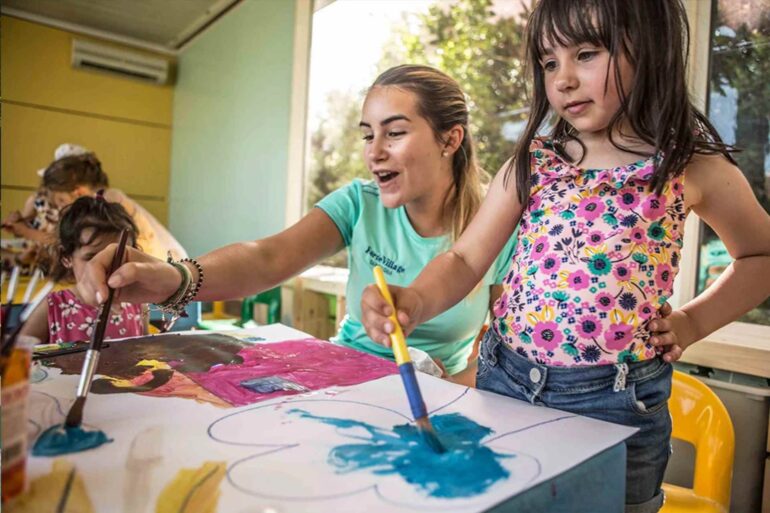
Here, children have the opportunity to try a variety of creative activities, such as drawing, painting, and ceramics. These three creative tools can help develop imagination, coordination, and expressive skills. Through drawing, for example, they can learn to transform ideas and thoughts into images, practicing observation, concentration, and freedom of expression. Painting, on the other hand, offers a broader space for experimentation with colors, shapes, and visual combinations, helping children communicate emotions and sensations through artistic language. Ceramics, finally, adds a very important tactile and manipulative dimension: shaping clay allows children to work on fine motor skills, spatial perception, and the ability to build something from scratch.
Every day, the activities follow a specific theme, and participants can take home what they create during the workshop. The Arts & Crafts Academy is open to children aged 2 and up of all nationalities (the staff speaks several languages, including Italian, English, French, German, and Russian).
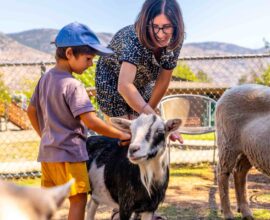
Alongside artistic workshops, Forte Village Resort also offers educational experiences in contact with nature, which mainly take place at the Nature Park, with its much-loved educational farm and synergistic vegetable garden. In this context, children can enjoy a different but complementary experience, coming into direct contact with the natural environment and learning through observation and practice. Activities include discovering typical local crops, using small gardening tools, observing the natural life cycles of plants, and learning the basics of cultivation.
For more information, you can call +39 070 9218180 or send an email to holiday@fortevillage.com.
Do you want to discover the benefits of creative workshops for children and enjoy a dream vacation in a true paradise? Discover Forte Village Resort in Sardinia