Aerial dance: benefits and tips for getting started
Aerial dance: benefits and tips for getting started
Practiced in suspension using tools such as silks or hoops, aerial dance is today one of the most widespread and appreciated disciplines. Its success is due not only to its spectacular and artistic nature, but also to the numerous benefits it offers: it helps tone and strengthen the entire body, improve coordination and flexibility, and at the same time develop concentration, body awareness, and mental well-being.
Although still relatively unknown to the general public, aerial dance has been gaining increasing popularity in recent years, attracting those looking for new ways to move their bodies beyond traditional forms of exercise. Much of its success lies in its ability to combine physical training, coordination, and creativity into a single practice.
But what does it actually involve? Aerial dance is performed in suspension, using apparatus fixed overhead, such as silks or hoops, that allow the body to move freely in space rather than on the ground. At first glance, it may seem complex or reserved for those with an athletic background, but in reality, it is based on progressive learning and is accessible even to complete beginners. As with pole dance, the initial stages focus on becoming familiar with the equipment, learning to support one’s body weight, and gaining control over basic movements.
With consistent practice, the body gradually adapts to this new way of moving: the arms get stronger, core stability improves, and overall coordination increases. Movements that initially feel challenging become more natural, allowing for the creation of increasingly fluid sequences. The element of suspension introduces a different perception of both space and the body, making each exercise not only a physical workout but also an experience of control and adaptation.
Another aspect that makes this discipline so appealing is its variety. There are several specializations, each with distinct characteristics, allowing you to choose the approach that best suits your preferences and starting level. Some focus on dynamic and continuous movement, while others require greater precision and control in holding positions. In all cases, progress is gradual, enabling steady improvement without unnecessary strain on the body.
The psychophysical benefits of aerial dance
Aerial dance is not simply an alternative form of exercise, but a comprehensive practice that engages both mind and body. Working in suspension completely changes the way our muscles are used, how balance is managed, and how the body is perceived in space, making every training session stimulating and never repetitive. Unlike many traditional workouts, aerial dance requires constant mental focus and active muscular control throughout every phase of the practice. There are no passive movements, as the body must continuously adapt, support itself, and maintain control. This leads to harmonious and functional muscle development, accompanied by an overall improvement in coordination and mobility.
At the same time, the need for concentration and precision helps strengthen the connection between mind and body, making the practice more effective, holistic, and deeply engaging.
Strength, flexibility, and control: why practice aerial dance
From a physical perspective, aerial dance is one of the most complete forms of training available. Working against gravity involves constant engagement of multiple muscle groups, particularly in the upper body. Arms and shoulders are intensively activated during climbs and suspensions, while the back plays a key role in maintaining stability and control.
The core (i.e., the central area of the body) is always engaged, and its control is one of the fundamental elements of the discipline. The abdominal and lower back muscles work together to maintain balance, support posture, and ensure fluid, precise movement. The legs, although used differently compared to other activities, also contribute to executing and managing movements, especially during extensions and transitions.
Another important benefit is the improvement of flexibility and joint mobility. The positions and movements included in each routine promote progressive muscle stretching, increasing elasticity, and reducing stiffness. Over time, this results in greater freedom of movement and improved posture, both during practice and in everyday life. Endurance also increases, allowing practitioners to hold positions longer without excessive fatigue.
How aerial dance improves mental and emotional well-being
In addition to physical improvements, aerial dance offers significant benefits on a mental and emotional level. The need to focus on each movement helps develop a strong mental presence, allowing practitioners to disconnect from daily distractions and concerns. This makes the practice particularly effective for reducing stress and restoring a sense of balance.
The learning process also plays a key role in building self-confidence. At the beginning, some movements may seem difficult or out of reach, but with consistency and practice, they gradually become more accessible. Overcoming these small challenges helps strengthen confidence in one’s abilities and fosters a more positive approach to both minor and major difficulties in everyday life.
Finally, the expressive component should not be overlooked. Even when not practiced at a performance level, the opportunity to move freely and creatively allows the body to become a means of expressing emotions, feelings, and your inner world. This stimulates imagination and makes each training session unique, transforming physical activity into an emotionally engaging experience.
Main aerial dance disciplines: hoop and silks
Within aerial dance, there are several disciplines, each with its own technical characteristics and execution styles. The choice of apparatus greatly influences the type of training, the sensations experienced during practice, and the overall style of movement. Some disciplines emphasize fluidity and dynamic sequences, while others focus more on control, balance, and static positions. Among the most popular are aerial silks and aerial hoop.
Aerial silks: technique, strength, and expression
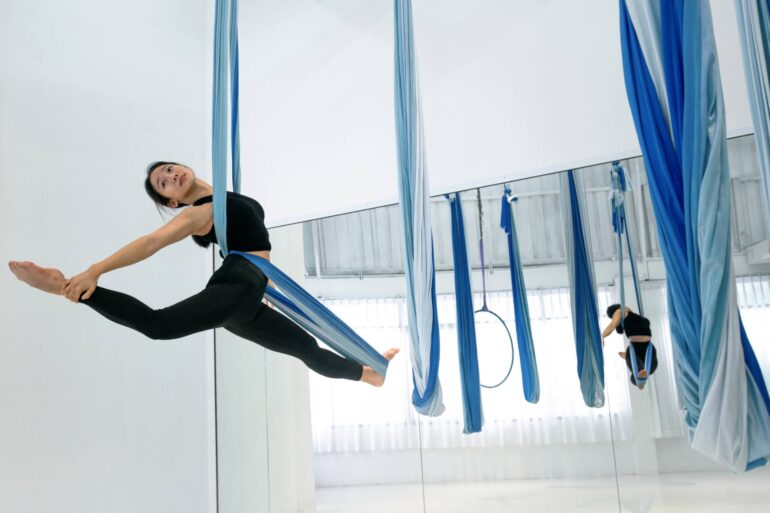
Aerial silks is one of the most iconic and recognizable forms of this discipline. It is practiced using two long pieces of fabric suspended from above, on which the performer climbs, wraps, and performs acrobatic movements. Figures include climbs, controlled drops, suspensions, and transitions that require strength, technique, and coordination.
Despite its strong athletic component, silks also offer great expressive freedom, turning each sequence into a true aerial choreography. This discipline is particularly suitable for those who want to progressively develop strength and endurance, as the body is trained in a gradual and structured way. One of the most fascinating aspects of silks is the possibility of creating continuous and fluid movements that combine technique and creativity, making every performance unique and visually captivating.
Aerial hoop: elegance and control
Aerial hoop (also known as lyra) is based on the use of a suspended circular metal apparatus, which allows for both static and dynamic movements performed with precision and elegance. The hoop provides a stable structure, enabling focused work on balance, core strength, and body control, making it a versatile apparatus suitable for both beginners and advanced practitioners.
Movements can be performed inside or outside the hoop, often combined with rotations and transitions that create visually striking effects. Compared to silks, the hoop requires greater control in static positions and a strong ability to maintain body alignment. With consistent practice, it is possible to develop increasingly complex sequences that combine strength and aesthetics, making this discipline particularly appreciated in performance contexts.
How to get started with aerial dance: 5 practical tips
Approaching the practice of aerial dance requires a gradual and mindful approach: although it may seem like a complex discipline, it is possible to begin without prior experience, as long as a few fundamental guidelines are followed. The initial goal is not to perform advanced moves, but to build a solid foundation based on strength, control, and familiarity with the equipment.
Following a structured path allows you to learn safely, avoiding common mistakes and reducing the risk of injury. Consistency is another key element: training regularly helps you improve progressively and become more comfortable with the movements.
Here are some tips to get started:
- Rely on qualified instructors: starting with the support of experienced teachers is essential to learn proper techniques from the very first lessons and to correct any posture or execution errors, helping to avoid bad habits that could slow progress or increase the risk of injury over time. Moreover, a guided path allows you to progress in a safer and more structured way.
- Develop basic physical preparation: although it is not necessary to already be fit, having a minimum level of strength and mobility can greatly facilitate learning. Incorporating exercises to strengthen the arms, core, and back, along with a regular stretching routine, helps the body adapt more quickly to suspension. This allows you to approach your first lessons with greater confidence and reduce initial fatigue.
- Progress gradually: one of the most important aspects when starting out is respecting the learning process. Beginning with slow and simple movements helps build a solid technical foundation, which is essential for gradually tackling more complex figures.
- Pay attention to safety: aerial dance takes place in suspension, so it is essential to practice in suitable environments with certified equipment. Checking that anchor points are secure and that mats or protective systems are in place is crucial, especially in the early stages. Safety also involves listening to your body and avoiding pushing movements beyond your limits.
- Be consistent: continuity is key to allowing the body to gradually adapt to new movements and consolidate acquired skills. Over time, consistency leads to noticeable improvements in both strength and fluidity, especially in transitions between different figures, making the practice increasingly natural and rewarding.
Discover the secrets of aerial dance at the Dance Academy of Forte Village Resort
Today, getting started with aerial dance is much easier than in the past, thanks to the growing number of specialized schools and academies offering courses suited to different levels, ages, and physical conditions. This allows anyone to experience the discipline gradually and safely — even while on vacation. Among the most renowned institutions in Italy is the Dance Academy of Forte Village, the acclaimed five-star resort located in the beautiful area of Santa Margherita di Pula, just a short distance from some of the island’s most stunning beaches and less than a 45-minute drive from Cagliari.
The academy’s program, open Monday to Friday from May 25 to September 4, goes beyond aerial dance and includes numerous disciplines that enrich the learning experience with diverse and complementary styles. These include classical ballet, modern dance, Latin American dances, social dance, Zumba, hip-hop, musical theatre, aerial, and pole dance. Classes are held at the Sport Academy Center and are organized flexibly, with group lessons divided by age and level, as well as the option of individual sessions upon request. This allows both beginners and more experienced practitioners to find the most suitable path for their needs in a stimulating, safe, and well-structured environment.
For further information or to book a lesson at one of the Forte Village academies, you can call +39 070 9218818 or email holiday@fortevillage.com.
Do you want to practice aerial dance and enjoy a dream vacation in a true paradise? Book your stay at Forte Village Resort in Sardinia