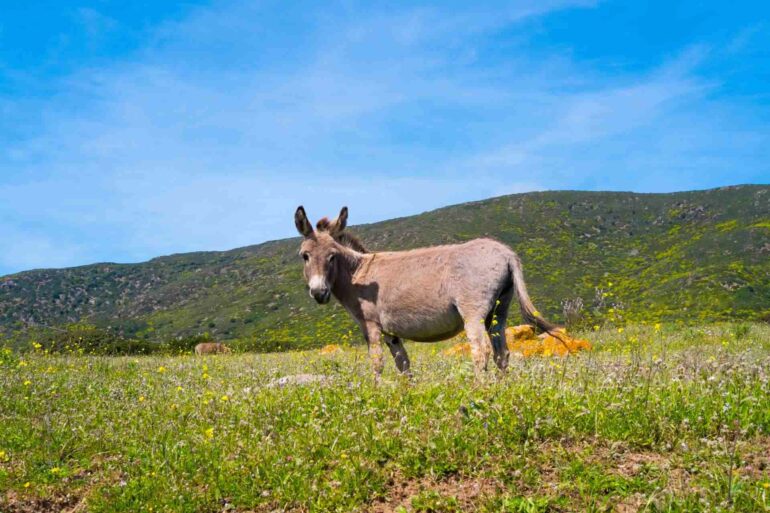
Sardinian donkey: origins, characteristics, and fun facts about a symbol of the island
The Sardinian donkey, a symbol of patience, hard work, and adaptability
Small, hardy, and lively in character, the Sardinian donkey is one of the island’s most representative animals, offering an opportunity to rediscover a heritage of biodiversity and traditions that deserves to be preserved and passed down.
The Sardinian donkey is one of Sardinia’s most distinctive animal breeds, as well as a symbol of the island’s rural history and traditions. Small in stature but surprisingly strong and resilient, this fascinating equine has accompanied the daily lives of local communities for centuries, becoming a valuable ally in agricultural activities and the transportation of goods along the most challenging paths.
Its ability to adapt to difficult terrain, the Mediterranean climate, and often demanding living conditions made it an indispensable presence for centuries, particularly in the countryside and small inland villages, where human labour was closely connected to that of animals. Its presence was so widespread that it became part of everyday habits, folk traditions and even the local language, as demonstrated by the many names still used to refer to it in different areas of the island (including ainu, molente, burriku and poleddu).
With the gradual development of agricultural mechanisation, the role of Sardinian donkeys changed profoundly, and their presence across the island progressively declined. Today, these animals continue to represent a symbol of tenacity, patience and adaptability. They also remain an important testament to Sardinia’s historical and natural heritage and are at the centre of initiatives dedicated to conserving native breeds and promoting the island’s biodiversity.
The origins of the Sardinian donkey and its connection to the island’s history
The history of the Sardinian donkey has its roots in the distant past, when these animals began to spread throughout the Mediterranean basin, becoming an essential resource for populations whose livelihoods depended on agriculture and livestock farming. Although the exact origins of the breed have not yet been fully established, it is believed that the first donkeys were introduced to Sardinia through trade with populations from North Africa and the eastern Mediterranean, probably as early as pre-Roman times.
Over the centuries, Sardinian donkeys gradually adapted to the island’s particular environmental conditions, developing physical characteristics that made them especially hardy and suited to living even in the most challenging areas. Their small size (their height at the withers generally ranges from 80 to 110 centimetres), sturdy limbs, and ability to travel long distances over uneven ground contributed to the spread of the breed, particularly in rural and mountainous areas, where it provided valuable assistance with everyday activities.
The Sardinian donkey in rural traditions
For generations, the Sardinian donkey was one of the main working companions of farming families. It was used to transport crops, firewood, water, and other materials, as well as to reach agricultural land that was difficult to access by other means. Its endurance and ability to thrive on a simple diet made it particularly well suited to the needs of rural communities, which often had limited resources.
Donkeys also played an important role in grinding cereals. They were used to power the stone millstones that produced flour, an activity from which the traditional Sardinian name molente derives. This name, still widespread in various parts of the island today, demonstrates just how closely the animal was connected to the activities essential to supporting families.
With the introduction of mechanised agricultural equipment, particularly from the second half of the twentieth century onwards, the use of donkeys in the countryside gradually declined, leading to a significant reduction in the breed’s population. Despite this change, the Sardinian donkey has retained strong cultural and identity-related significance, becoming one of the most recognisable symbols of the island’s rural civilisation.
Today, thanks to the commitment of breeders, associations and organisations dedicated to safeguarding native breeds, the Sardinian donkey is at the centre of conservation and promotion projects. Protecting it is not only about ensuring the survival of an animal breed, but also about preserving a heritage of knowledge, traditions and rural practices that form an important part of Sardinia’s history.
Characteristics of the Sardinian donkey: appearance, size, and temperament
One of the most noticeable characteristics of the Sardinian donkey is its small stature compared with many other donkey breeds. Its height at the withers generally ranges from 80 to 110 centimetres, while its body has a compact build, with a rather elongated trunk, a short neck and slender but sturdy limbs.
Its head is relatively large in proportion to its body, with a generally straight profile and expressive eyes, while its long, mobile ears are among its most recognisable features. Its hooves are small, hard and particularly well suited to travelling along rocky paths and uneven terrain, an essential characteristic for an animal that was used for centuries in Sardinia’s countryside and mountainous areas.
Another distinctive feature of the Sardinian donkey is its coat colour, generally mouse grey, with shades ranging from light grey to darker tones. The belly, muzzle and area around the eyes are often lighter in colour. Particularly recognisable is the so-called St Andrew’s cross, a marking formed by a dark stripe running lengthwise along the back and a transverse band across the shoulders. This marking, also found in other donkey breeds, is one of the typical features of the Sardinian donkey’s appearance. Some individuals may also have faint dark stripes on their limbs. The mane is generally short and upright, while the tail, covered with shorter hair on its upper part, ends in a thick tuft.
Beyond its physical appearance, one of the characteristics that makes the Sardinian donkey particularly interesting is its temperament. Intelligent, curious, and generally sociable, it is an animal capable of developing a relationship of trust with humans, especially when approached with patience and respect. The proverbial stubbornness attributed to donkeys is actually often an expression of their caution. Unlike other equines, donkeys tend to stop and assess a potentially dangerous situation before proceeding, a behaviour that demonstrates their awareness of their surroundings.
The Sardinian donkey also has a good memory and a remarkable ability to learn. These qualities, together with its sensitivity, make Sardinian donkeys particularly interesting in educational and environmental awareness activities, during which children and adults can learn about animal behaviour and how to interact with animals while respecting their natural needs.
Discover the secrets of the Sardinian donkey at Forte Village Nature Park
The Sardinian donkey is a particularly interesting animal to observe up close, especially for children. Learning about its habits, recognising its distinctive features and understanding its role in the island’s history provides a valuable opportunity to discover Sardinia’s biodiversity and develop greater awareness of animal protection. This is an experience that can now also be enjoyed at Forte Village Nature Park, a green space within the renowned resort in Santa Margherita di Pula, where adults and children can discover numerous animal species, both native and non-native, and deepen their knowledge of the island’s natural heritage.
Among the park’s residents are Sardinian donkeys themselves, alongside Giara horses, Shetland ponies and a distinctive white Asinara donkey. The experience then continues with the discovery of the Nature Park’s other animals, including majestic fallow deer and numerous species of ornamental birds, in an environment designed to combine fun, learning and respect for nature.
Access to Forte Village Nature Park is exclusively through guided tours, scheduled twice a week, on Tuesdays and Thursdays from 10:00 am to 11:00 am, departing from the Children’s Wonderland. During the tour, younger visitors will also receive the Nature Park Passport, an illustrated booklet containing information about the species present, games, and spaces for collecting stamps. Booking is mandatory.
For more information about Forte Village Nature Park or to arrange a stay at the resort in Santa Margherita di Pula, contact +39 0709218818 or send an email to holiday@fortevillage.com.
Would you like to enjoy a dream holiday in a true natural paradise? Discover Forte Village Resort in Sardinia